
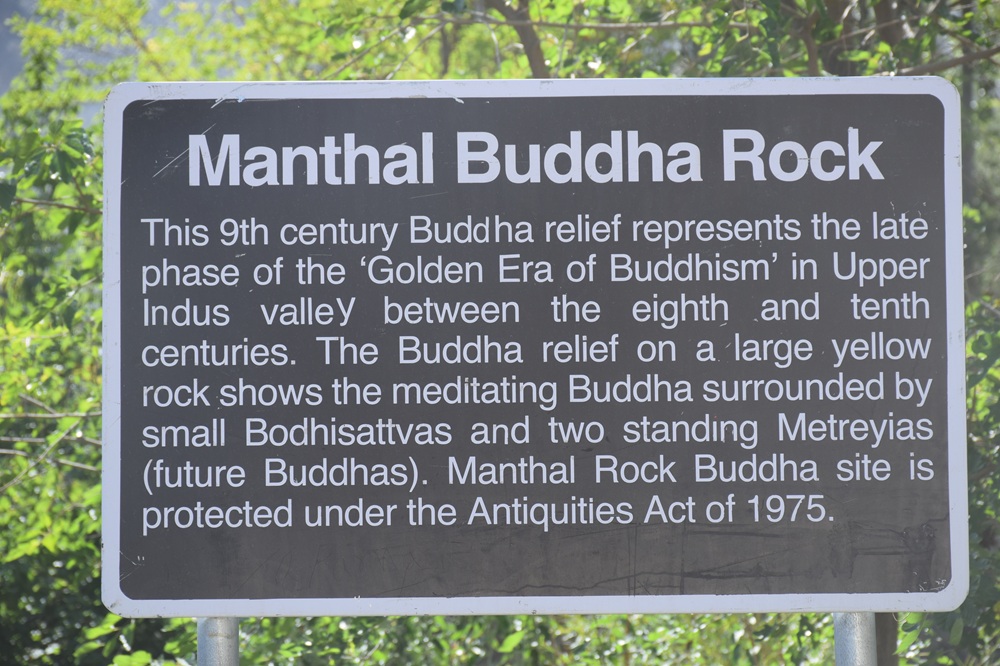
The Manthal Buddha Rock is one of Pakistan’s most significant Buddhist archaeological treasures. Carved directly into a massive granite boulder during the 8th century CE, it offers a remarkable glimpse into a time when Baltistan was an important centre of Buddhism.
Long before Islam arrived in the region during the 14th century, these valleys lay along ancient trade routes linking Tibet, Kashmir, India and Central Asia, allowing ideas, religions and cultures to travel through the mountains.
Where is it?
The Manthal Buddha Rock is located in Manthal village, just off Sadpara Road in Gilgit-Baltistan, approximately 3 km from Skardu town.
What you’ll see?
The carving depicts a rich Buddhist scene centred around Shakyamuni (Sakya Muni) Buddha, seated on a lotus in a posture of meditation and renunciation.
Surrounding the central figure are:
Twenty smaller seated Buddhas arranged in a square.
Four monumental standing Buddhas positioned around them.
Ancient inscriptions, carved deeply into the stone.
A visitor from over a century ago
The monument gained international attention through Scottish traveller Jane Ellen Duncan, who visited Baltistan and documented it in her 1906 book A Summer Ride Through Western Tibet.
Searching for Buddhist remains in Baltistan, she described her discovery:
“It proved to be a large and important relic of antiquity. It is of granite, 18 or 20 feet high, and nearly as wide… its face has been carefully smoothed and is of a pale buff colour, in strong contrast with the dark boulders surrounding it.”
She also noted a square hole above the Buddha’s head, which her guide explained had once been used to hold a ceremonial light. (This can be seen in the photograph).
Understanding the carvings
Duncan recorded an interpretation from a former Buddhist lama from Tibet, who identified the figures as:
The central seated figure: Shakyamuni (Sakya Muni), the historical Buddha.
The two large standing figures: Maitreya, the Future Buddha.
The twenty smaller Buddhas: Buddhas from previous cosmic ages (Kalpas).
The figure above the central Buddha: The Buddha of the Kalpa immediately preceding the present one.
Why it matters?
Today, the Manthal Buddha Rock stands as a powerful reminder that Pakistan’s story stretches far beyond its Islamic heritage. It reflects centuries of cultural exchange, pilgrimage and trade that shaped this mountain crossroads, and continues to fascinate archaeologists, historians and travellers alike.